Learn about Rain Gardens and Bioswales at RCC

The following is a Press Release put out by Rogue Community College about the project Sustainable Rogue Valley is doing in collaboration with them on the Grants Pass Redwood Campus.
 

14-BioswaleProject
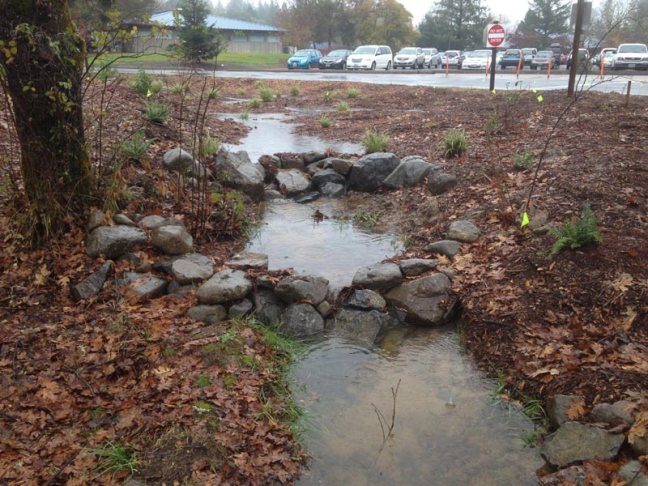
The Rain Garden at RCC after the fall planting day

Grants Pass-Rogue Community College (RCC) and Sustainable Rogue Valley are working together to complete the demonstration Rain Garden and Bioswale on the RCC Redwood Campus to show how to help protect stormwater pollution from fouling freshwater ecosystems.

The demonstration project at the RCC Redwood Campus is located next to the Josephine Building at 3345 Redwood Highway in Grants Pass. Volunteers are needed to help complete the project. Anyone who wants to get involved and experience this project firsthand is invited to join the Sustainable Rogue Valley group at the Josephine Building parking lot on:

  • Friday, Feb. 16, from 10 a.m. to 2 p.m., to complete wetland and flower planting.
  • Friday, March 16, from 10 a.m. to 2 p.m., to construct a trail designed to encourage people to walk and discover the project.
  • Earth Day, Thursday, April 19, at noon and 1 p.m., there will be tours of the site.

RCC’s demonstration rain garden collects rainwater runoff from impervious landscapes such as parking lots and roads and filters the water through a bioswale using unique wetland plants and organic matter that acts as a sponge that holds and breaks down contaminants and pollutants while letting water seep into the ground or enter natural drainage systems. With a healthy and varied plant community, rain gardens can produce a pleasing environment while providing a vital function in the watershed.

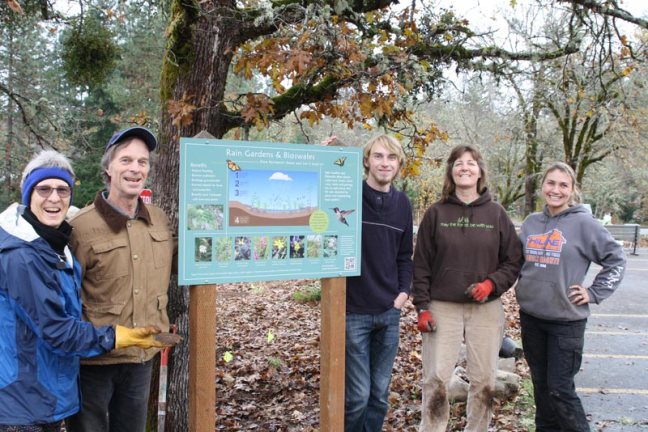
Signs are posted on-site to explain the project and its goals, the pattern of runoff, types of wetland plants, and how bioswales improve watershed health. “We hope this demonstration site will inspire others to build rain gardens and bioswales to improve water quality and beautify the landscape,” said Charles Rogers, the RCC science instructor managing the project.

This project has been funded by the Oregon Watershed Enhancement Board to construct the drainage basin and filling it with mulch. The local Williams Creek Watershed Council completed that stage during the summer of 2017. Additional funding was provided by the RCC Foundation and Ashland Food Co-op for plants and materials to complete the rain garden.

Sustainable Rogue Valley is a local group dedicated to fostering sustainable practices through community service and education.

Individuals and local groups interested in getting involved in planting, shaping and maintaining this active demonstration project can visit www.sustainableroguevalley.org for more information. If you would like to help with completing the rain garden, contact Rogers at crogers@roguecc.edu.

Sustainable Rogue Valley March Meeting – Sunday March 11 – 12:30

RainGarden-MonkeyFlower
Fairgrounds Rain Garden

Join us for cookies and chat about how we can build a more resilient community… Sunday’s Agenda includes:

Fairgrounds Gardens
RCC Raingarden and Bioswale
Stream School (April 14) at RCC
Earth Day (April 19) at RCC
Blue Zone Project
Sustainability Class
Local Recycling
ACES

See you at the UU Fellowship at 129 NW E Street, Grants Pass, OR

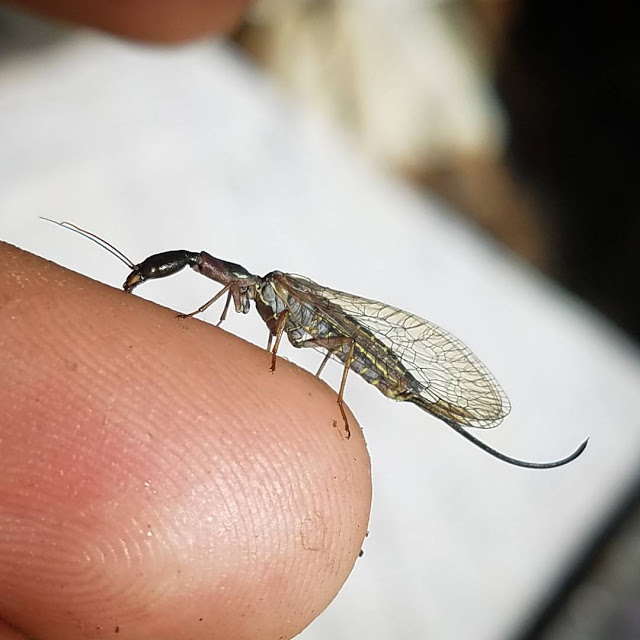
Parasitoid Wasps of Southern Oregon

ParasiteWasp2

“Hi! This is about parasitic wasps, some of the coolest wasps. They’re kind of like H.R. Giger’s Alien (you know, like the one that burst out of John Hurt’s chest in 1979). You may not like wasps, but they’re pretty fascinating nonetheless. They’re pretty useful biocontrol agents, and though you might not see them you would notice the difference if they were gone. I learned some interesting things about parasitoid venoms and mating strategies. Have a read, or maybe just check out the pictures.” Travis Owen


ParasiteWaspTrevorOwen

Parasitoid Wasps of Southern Oregon

Anyone that knows me knows that I love wasps. I think you should love them, too. Here I will attempt to familiarize you with the world of the non-stinging wasps known as the parasitoids. Parasitic wasps do not have true stings, as the aculeate wasps [and bees] do. These parasitoids have ovipositors, which are used to lay, or sometimes inject, eggs. While there are aculeate parasitoids, the aculeates do not have ovipositors. (The exception is the Chrysididae, the cuckoo wasps, which are aculeates which evolved their own unique ovipositors independently from the parasitoids featured in this piece.) The aculeate sting evolved from an ovipositor many millions of years ago…. READ MORE

February Sustainable Rogue Valley meeting – Sunday Feb. 11 – 12:30 pm

community

Come join us for Gary’s famous cookies and interesting conversation about important issues, with interesting people who care about making our world a better place for all of us to live!  Some of the topics we will discuss this month are:

  • Report on the Rogue Indivisible This Land is Your Land workshop
  • Fairgrounds Gardens
  • RCC Raingarden and Bioswale
  • Stream School (April 14) at RCC
  • Earth Day (April 19) at RCC
  • Blue Zone Project
  • Sustainability Class
  • Local Recycling
  • ACES

See you at the UU Fellowship at 129 NW E Street, Grants Pass, OR

Native Bees of America

Native bees are an unappreciated treasure, with 4,000 species from tiny Perdita to large carpenter bees, they can be found anywhere in North America where flowers bloom.

Most people don’t realize that there were no honey bees in America until the white settlers brought hives from Europe. These resourceful insects promptly managed to escape domestication, forming swarms and setting up housekeeping in hollow trees, other cavities or even exposed to the elements just as they had been doing in their native lands.

Native pollinators, in particular bees, had been doing all the pollination in this continent before the arrival of that import from the Old World. They continue to do a great deal of it, especially when it comes to native plants.

Source: https://bugguide.net/node/view/475348
Poster: http://beesinyourbackyard.blogspot.com/p/poster.html


Image may contain: text and outdoor

This Land is Your Land: Our Unique SW Oregon Environment. Can We Foster Resilience?

Rafting on the RogueEnvironmental Workshop  –  FREE
Saturday, February 3, 2018 at Wild River Pub in Grants Pass
533 NE F Street, Grants Pass, OR 97526
12:00 – 4:00 p.m.

This FREE workshop, organized by Rogue Indivisible, is an excellent chance to
learn from local experts about our complex southwest Oregon environment, what
makes it unique, and what we can do to help in sustainable management of our
region’s natural resources.

• Overview of SW Oregon’s Ecological Systems – Dr. Tom Atzet,
Ecologist
• A Rogue Climate in Our Valley: Trends, Projections, Consequences
– Dr. Alan Journet, Co-Facilitator, Southern Oregon Climate Action
Now
• What is Restoration Forestry and Why is it Important? – Gary
Clarida, Restoration Forester
• 25 Things You Can Do to Help Save Our Rogue Valley Environment
– Bob Bath, High School Science Teacher
• Local Recreational Trails and Collaboration to Benefit Rogue
Valley Economy and Communities – Hope Robertson, Founder/
President Siskiyou Upland Trails Association
• The Ecology of Relationships: Community Collaboration in
Natural Resource Management – Jack Shipley, Founder, Applegate
Partnership
• Wrap-Up Panel Discussion – All Presenters available for Questions

No fee for attending! Space is limited. Please register early!

Coffee, tea, water and light snacks will be provided.

Email eco-team@rogueindivisible.org to sign up or register online at
rogueindivisible.org – Click on Issues, then on Environment and scroll down to the registration link under Environmental Workshop
rogueindivisible.org

New meeting time! Sunday, Jan. 14th – 12:30 pm. Join us!

Join us Sunday at 12:30 at the UU Fellowship at 129 NW E St., Grants Pass, OR for our Monthly meeting.  We will be meeting every SECOND Sunday from now on – so change your calendars so you don’t miss a meeting!

This months meeting facilitator is Constance Palaia and this months agenda topics are:

Contact information in the Catalyst
Financial Report
Fairgrounds Gardens
RCC Raingarden and Bioswale
Earth Day (RCC event, UUGP)
Blue Zone Project
Transition Handbook/RCC Sustainability Class
ACES
Miscellaneous

Join us and help build a more resilient community!

A Simpler Way: Crisis As Opportunity (Full Documentary)

Below we have posted the full documentary of “A Simpler Way: Crisis as Opportunity”, an inspiring new documentary produced by Jordan Osmond (http://happenfilms.com/) and Samuel Alexander (http://simplicityinstitute.org/). We encourage people to organise their own, non-profit screenings of this important new film in the hope of sparking a broader cultural conversation about the importance of voluntary simplicity, permaculture, and economic relocalisation in an age of limits.

Please share this film with friends and family and help spread the word through your online networks.

The film can also be purchased for download at Happen Films.

The overlapping economic, environmental, and cultural crises of our times can seem overwhelming, can seem like challenges so great and urgent that they have no solutions. But rather than sticking our heads in the sand or falling into despair, we should respond with defiant positivity and try to turn the crises we face into opportunities for civilisational renewal.

During the year of 2015 a small community formed on an emerging ecovillage in Gippsland, Australia, and challenged themselves to explore a radically ‘simpler way’ of life based on material sufficiency, frugality, permaculture, alternative technology and local economy. This documentary by Jordan Osmond and Samuel Alexander tells the story of this community’s living experiment, in the hope of sparking a broader conversation about the challenges and opportunities of living in an age of limits.

The documentary also presents new and exclusive interviews with leading activists and educators in the world’s most promising social movements, including David Holmgren (permaculture), Helena Norberg-Hodge (localisation), Ted Trainer (the simpler way), Nicole Foss (energy and finance), Bill Metcalf (intentional communities) and Graham Turner (limits to growth).

TO SUPPORT THE GREAT WORK OF SAMUEL AND JORDAN

Please visit their website’s or support them on patreon.com

Samuel Alexander: https://www.patreon.com/user?ty=h&u=3404767 (establishing a ‘simpler way’ permaculture project and education centre)

Jordan Osmond: https://www.patreon.com/happenfilms?ty=h (funding a trip around NZ filming people exploring permaculture, tiny houses, natural building, etc.).

RCC Rain Gardens and Bioswales

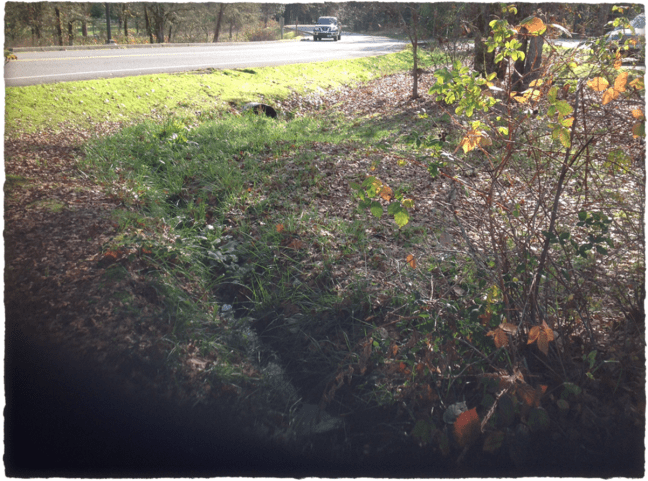
Proposed Bioswale area at RCC

Sustainable Rogue Valley, in conjunction with other funders, is planning to construct Raingardens and Bioswales on the Rogue Community College property in Grants Pass, Oregon. Raingardens are made to collect rainwater in ponds and maintain a healthy plant community while encouraging water to slow down and filter into the ground. They produce a pleasing environment while providing a vital function in the watershed. Plant communities can be focused on butterfly migration, bees and insects, as well as firewise resistant plants.

Bioswales are made to collect rainwater runoff and filter through wetlands where unique wetland plants are growing. These plants will help break down pollutants such as oil from parking lots and roadways as they filter into the ground during runoff. Bioswales contain organic matter that acts as a sponge along with plants that hold and break down contaminants from impervious landscapes such as parking lots and roads.

The wetlands on RCC campus will collect runoff, filter and clean contaminants, and send the water downstream or into the ground to enter the natural drainage systems. There are several wetland sites planned in this project that will receive runoff in a series of bioswales designed around the existing culverts and drainage patterns. Signs posted onsite will explain the project and its goals, showing the pattern of runoff, types of wetland plants growing, and how this could help clean water and improve watershed health. We hope this demonstration site will inspire others to build Raingardens and Bioswales to improve water quality and beautify the landscape.

Sustainable Rogue Valley is an affinity group to the Grants Pass Universal Universalists, and is associated with Rogue Community College Faculty and Facilities Department. SRV has received funding from The Ashland Food Coop and is also applying for restoration grants from Oregon Watershed Enhancement Board through the Rogue Valley Small Grant Team. Support is sought from Rogue River Watershed Council as well as Rogue Basin Partnership, and the Rogue Community College Green Team. This will be a collaborative effort to bring communities together to show how sustainable practices can benefit everyone.

rccraingardenproject1
Future bioswale at RCC

Bees of 2016 of Southwestern Oregon

The following is by Rogue River resident Travis Owen:
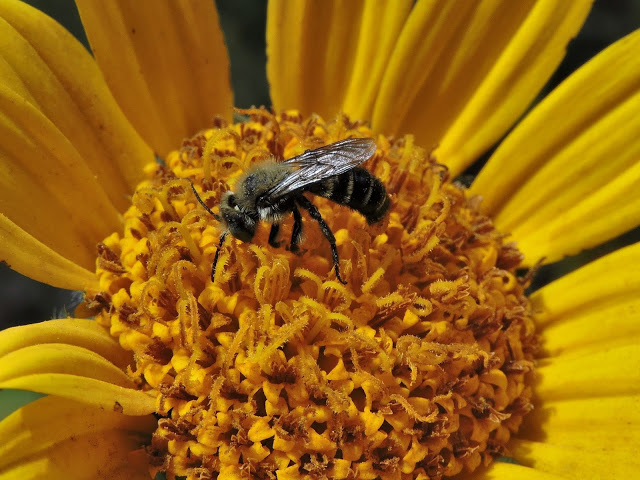
This is an article I wrote about the (mostly native) bees I photographed this year in the Rogue Valley, at least 21 species in 4 families are represented in photos along with some personal observations and life histories. One particularly interesting discovery, bees are basically fuzzy vegan wasps that developed branched hairs adapted to carrying pollen to feed their young (true wasps have simple hairs and are, for all intensive purposes, carnivores).
Travis Owen  — The Amateur Anthecologist

beesofsouthwestoregon

When most people hear the word bee, images of honeybees (Apis mellifera, Apidae) and the associated tales of declines come to mind. However, bees are much more diverse and interesting than the honeybee leads one to believe. There are at least thirty-five hundred species of native bees in America north of Mexico alone, and over twenty-thousand described species worldwide (probably many more). They live diverse lifestyles, but unlike the honeybee most live solitary lives. A similar variance can be seen in wasps, particularly predatory wasps which bees evolved from….

Sustainable Rogue Valley’s “Cleaner Air Grants Pass” Event

Nicholas Caleb, the Staff Attorney for Portland based Neighbors for Clean Air will join us Friday, Sept. 9, 10am to 1pm at 1205 SE Harvey Drive, Grants Pass, home of Michelle and David Keip. Anyone interested is welcome. For RSVP or more info contact Michelle Keip 541-244-1885.

stethoscope_airNick will provide an explanation of how Oregon’s current air regulatory program works, an update on the Cleaner Air Oregon process to date, what to expect in the future, what air quality advocates are seeking through the reform process, and how you can become a strong advocate for clean air in our community. The intent is to help us prepare before the Sept. 13th Clearer Air Oregon public forum in Medford and to discuss the Industrial Emmissions Regulatory Reform process that is underway right now. Nick has been involved in environmental advocacy at the legal, policy, grassroots advocacy and academic levels.

Bertie and the Birdbath

Permaculture-birdbat
The Hypertufa birdbath created by Bertie Foltz.


Thanks to Bertie Foltz and her talent in making objects with hypertufa, a special lightweight concrete mix, we have a birdbath for the Permaculture Garden bed at the Fairgrounds. It is filled regularly with special dripper in the irrigation system. The advantage to having it on the ground is that frogs and toads and other small creatures will have access to it. The disadvantage – if you have a cat is that they will have access to those creatures as well as the birds.

Thanks for the birdbath, Bertie!


Insect Hotel installed at Fairgrounds

Mike&InsectHotelIn early June Mike Nelson completed and installed an Insect Hotel in the Bees and Pollinators bed at the Firewise Gardens project at the Fairgrounds! As you can see from the picture it’s truly a work of art! Each section is created as habitat for a different sort of pollinator insect.
These “Insect Hotels” are extremely popular in Europe where the natural habitats have been decimated by human populations, and so farmers, homeowners, parks and schools have taken to creating sometimes very large and elaborate “insect hotels” in order to compensate. They can be as small and simple as a coffee can filled with bamboo tubes to the type of thing Mike created and much much larger. Do a Google Image search for “Insect hotel” and you will see dozens of examples.

This bed also includes a “watering tray” since bees and other pollinators need water, too. It’s a small clay tray filled with sand and pebbles allowing safe and easy access to the water without drowning. Next to this tray is a bare sandy “bank” surrounded by grasses that can act as a nesting site for the many types of ground nesting bees native to Oregon.

The garden is also filled with a variety of plants that will bloom from late winter through the summer, offering ongoing food (nectar).

The signage for the beds will come soon – but in the meantime you won’t have any trouble finding Mike’s wonderful Insect Hotel. Go to the Josephine County Fairgrounds and check it out – second bed on the left!

The Japanese Town That Produces No Trash [VIDEO]

Trash is a big problem around the world. Our society creates a ton of waste, with the average person producing 4.3 of trash a day according to the Duke Center for Sustainability. Kamikatsu, Japan has a population of 1,700, but despite that they produced no waste last year. Their trash success is thanks to an extensive recycling system, which puts trash into 30 plus separate categories for repurposing. Take a look at this video for a rundown of how 1,700 were able to produce less trash last year than a single person here does in one day.

Source: The Japanese Town That Produces No Trash [VIDEO]