Blog

Bertie and the Birdbath

Permaculture-birdbat
The Hypertufa birdbath created by Bertie Foltz.


Thanks to Bertie Foltz and her talent in making objects with hypertufa, a special lightweight concrete mix, we have a birdbath for the Permaculture Garden bed at the Fairgrounds. It is filled regularly with special dripper in the irrigation system. The advantage to having it on the ground is that frogs and toads and other small creatures will have access to it. The disadvantage – if you have a cat is that they will have access to those creatures as well as the birds.

Thanks for the birdbath, Bertie!


Insect Hotel installed at Fairgrounds

Mike&InsectHotelIn early June Mike Nelson completed and installed an Insect Hotel in the Bees and Pollinators bed at the Firewise Gardens project at the Fairgrounds! As you can see from the picture it’s truly a work of art! Each section is created as habitat for a different sort of pollinator insect.

These “Insect Hotels” are extremely popular in Europe where the natural habitats have been decimated by human populations, and so farmers, homeowners, parks and schools have taken to creating sometimes very large and elaborate “insect hotels” in order to compensate. They can be as small and simple as a coffee can filled with bamboo tubes to the type of thing Mike created and much much larger. Do a Google Image search for “Insect hotel” and you will see dozens of examples.

This bed also includes a “watering tray” since bees and other pollinators need water, too. It’s a small clay tray filled with sand and pebbles allowing safe and easy access to the water without drowning. Next to this tray is a bare sandy “bank” surrounded by grasses that can act as a nesting site for the many types of ground nesting bees native to Oregon.

The garden is also filled with a variety of plants that will bloom from late winter through the summer, offering ongoing food (nectar).

The signage for the beds will come soon – but in the meantime you won’t have any trouble finding Mike’s wonderful Insect Hotel. Go to the Josephine County Fairgrounds and check it out – second bed on the left!

The Japanese Town That Produces No Trash [VIDEO]

Trash is a big problem around the world. Our society creates a ton of waste, with the average person producing 4.3 of trash a day according to the Duke Center for Sustainability. Kamikatsu, Japan has a population of 1,700, but despite that they produced no waste last year. Their trash success is thanks to an extensive recycling system, which puts trash into 30 plus separate categories for repurposing. Take a look at this video for a rundown of how 1,700 were able to produce less trash last year than a single person here does in one day.

Source: The Japanese Town That Produces No Trash [VIDEO]

Invasive species will save us: The new way we must think about the environment now – Salon.com

Nature no longer congregates where we expect to find it — so conservationists must radically rethink priorities…

Source: Invasive species will save us: The new way we must think about the environment now – Salon.com

This article in Salon Magazine is an excerpt from Fred Pearce’s new book called “The New Wild: Why Invasive Species Will Be Nature’s Salvation”. It’s a fascinating look at the way species of plants and animals are actually moving around and adapting to unusual environments (like cities!) and will give you a fresh look at the whole idea of “invasive species”…

Communities Grow Stronger with Fruit Tree Projects

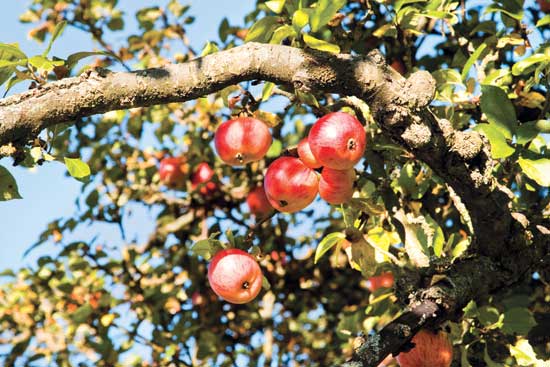
Photo By Heike Brauer

Fruit Tree Projects are helping feed communities all over the world. Here’s how the Santa Cruz fruit tree project got started.

By Maria Grusauskas, from Shareable.

Article courtesy of Utne Reader

Over the past few years, “Fruit Tree Projects” have been popping up all over the world, from Vancouver and Portland, to New Orleans, to Fiji and Australia and beyond. They start small, with just one or two proactive individuals who are pained by the sight of perfectly good fruit in the late stages of decomposition.

Some Fruit Tree Projects redistribute their fruit harvests to undernourished communities, while others gobble them up themselves, and many celebrate the harvest by getting together and processing large quantities of fruit into any number of delicacies.

Even with the variations in types of Fruit Projects out there, one basic truth remains the same: the only thing standing between a hungry belly and the world’s excess fruit supply is a knock on a neighbor’s door.

For Steve Schnaar, (whose childhood memories include picking apples with his family), knocking on doors to inquire about overladen fruit trees was a hobby that soon blossomed into the Santa Cruz Fruit Tree Project, now in its third year in Santa Cruz, California.

“I have a long history of knocking on people’s doors and saying ‘it looks like you have more apples than you can handle,’ or cherries, or whatever it may be, and it’s usually true—most people with a big tree aren’t using it all, or are happy to share,” says Schnaar.

“Sure, a lot of people are intimidated to knock on strangers’ doors … but I don’t have that problem. People can say no if they want to say no.”

The success rate is surprisingly high, especially because most people—especially if they live alone—can’t eat all of the fruit produced by a single tree, and Schnaar estimates about nine out of 10 people say yes to sharing their excess.

Do-it-yourself fruit processing is at the heart of The Santa Cruz Fruit Tree Project, and the community that’s been growing out of it. Most harvests are followed by a gathering that teaches how to preserve the fruit they harvest—from drying persimmons using the traditional Japanese method Hoshigaki, to fermenting the fruit into wine with local DIY winemakers. They’ve also hosted apple cider pressing parties (with a bike-powered press, of course), made vinegar and countless preserves, from marmalades to chutneys. And when there’s still too much fruit to go around, or the fruit is a little bit too mushy to give away, the chef of local restaurant India Joze often finds a culinary use for it.

The post-harvest events bring together growers, community members, and local food experts, and they’re a birthplace for lasting relationships and useful skills promoting a sustainable culture.

Schnaar’s project would have fizzled out had it not been for his devotion to it, and the whole-hearted embrace it has received from the community. Most of the fruit hosts have welcomed him and his fruit harvesters back each year, and the word is spreading. Harvests that used to see only a handful of people are now numbering dozens to even 40 or 50 people.

Read this article in its entirety, including an interview with Steve Schnaar at Shareable.

COWSPIRACY: The Sustainability Secret

COWSPIRACY: The Sustainability Secret, is a groundbreaking feature length environmental documentary, following an intrepid filmmaker as he uncovers the most destructive industry facing the planet today and investigates why the world’s leading environmental organizations are too afraid to talk about it. This shocking yet humorous documentary is as eye-opening as “Blackfish” and as inspiring as “An Inconvenient Truth”.

Source: COWSPIRACY: The Sustainability Secret

Power to the People

Why the rise of green energy makes utility companies nervous.

From the June 2015 New Yorker Magazine article by Bill McKibben

Light socket
CONSTRUCTION BY STEPHEN DOYLE / PHOTOGRAPH BY ERIC HELGAS

Mark and Sara Borkowski live with their two young daughters in a century-old, fifteen-hundred-square-foot house in Rutland, Vermont. Mark drives a school bus, and Sara works as a special-ed teacher; the cost of heating and cooling their house through the year consumes a large fraction of their combined income. Last summer, however, persuaded by Green Mountain Power, the main electric utility in Vermont, the Borkowskis decided to give their home an energy makeover. In the course of several days, coördinated teams of contractors stuffed the house with new insulation, put in a heat pump for the hot water, and installed two air-source heat pumps to warm the home. They also switched all the light bulbs to L.E.D.s and put a small solar array on the slate roof of the garage.

The Borkowskis paid for the improvements, but the utility financed the charges through their electric bill, which fell the very first month. Before the makeover, from October of 2013 to January of 2014, the Borkowskis used thirty-four hundred and eleven kilowatt-hours of electricity and three hundred and twenty-five gallons of fuel oil. From October of 2014 to January of 2015, they used twenty-eight hundred and fifty-six kilowatt-hours of electricity and no oil at all. President Obama has announced that by 2025 he wants the United States to reduce its total carbon footprint by up to twenty-eight per cent of 2005 levels. The Borkowskis reduced the footprint of their house by eighty-eight per cent in a matter of days, and at no net cost.

READ MORE
http://www.newyorker.com/magazine/2015/06/29/power-to-the-people

Beautiful, hard-working Rain Gardens

Rain GardenThe following is a blog post from The Holistic Garden blog by Barb Allen:

Last fall we built a rain garden that collects rainwater that runs from the roof and driveway. Normally this water would have run down the slope behind the house into a creek and off the property. Now it fills up the rain garden and soaks into the ground in a few hours, replenishing the groundwater that feeds our well. In the midst of a serious drought that’s pretty comforting.  It worked so well, we’re creating mini-rain gardens and swales all over the property now to slow down the flow and allow it to soak into the soil.

I have a half acre of garden that I water through the dry summer months, so it would be hard to store enough water in a cistern or in plastic tanks to take care of 4 – 5 months of watering. And the house is down slope from the garden so I couldn’t figure out a way to collect it in tanks and get it uphill to the garden. I chewed on that problem for a couple years. Then, in the process of looking for answers online, I ran across the concept of “rain gardens”, and the fact that they hold water, allowing it to soak into the soil and replenish the groundwater.  Around the same time I came across a story by Geoffrey Lawton of Permaculture fame, about a property where they put in a series of swales running down a slope. After a couple years of collecting rainwater in the swales, a spring popped out on the hillside!  Suddenly the idea of saving rain water in the GROUND seemed like the simplest and most natural solution!

Rain Garden project - digging started.
Rain Garden project – digging started.

Rain gardens were created originally for a more urban/suburban setting, as one solution to the problem of the massive amounts of rainwater that flow from roofs and driveways, patios and streets into storm drains and from there into local streams and rivers, carrying all sorts of nasty pollutants picked up along the way.  Before humans created so much impervious surface – rain used to soak into the ground in forests, meadows and prairies – continually recharging the aquifers and groundwater which in turn fed streams and rivers. Now we are using up the water in the these aquifers faster than it is being replaced. Much faster.  The pollution-filled water that runs off the hard surfaces and into streams and rivers is causing un-natural flooding and all sorts of serious problems for fish and wildlife.

Starting to add log edges to rain garden
Starting to add log edges. Next we added logs to the center of the berms, creating “hugelkulturs” on either side.

There are campaigns all across America, Australia and the UK, working to encourage homeowners and businesses to build rain gardens to deal with this runoff from impermeable surfaces. I read of at least one area that is now requiring any new home or business being built, to include a rain garden big enough to handle all the rain water from the roof, sidewalks, driveways and parking lots.

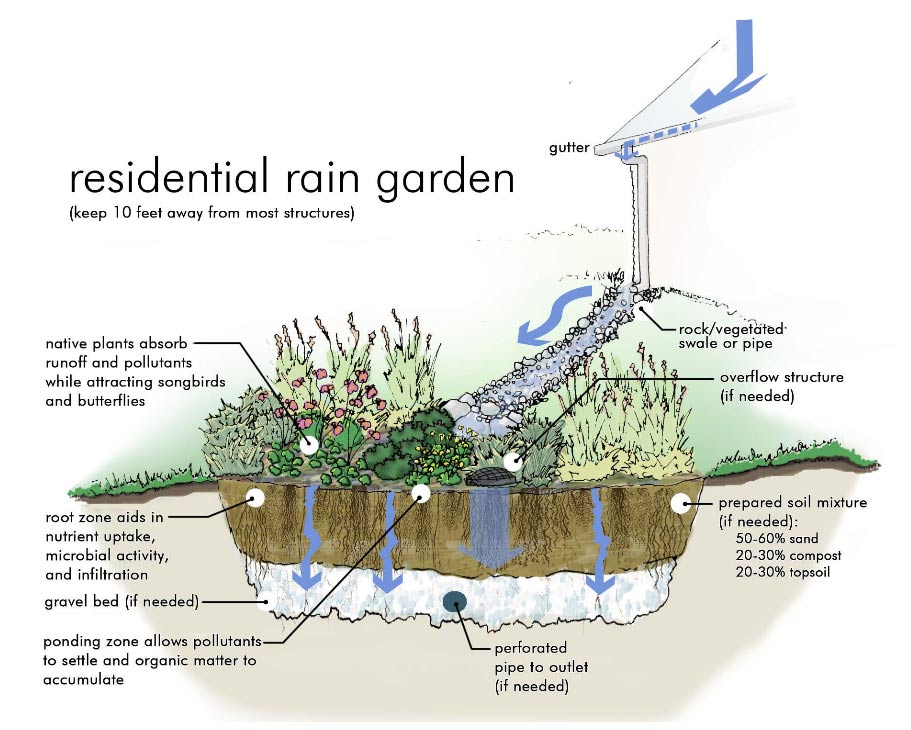
The idea is really fairly simple. A depression is dug at the lower end of a property – or somewhere at least 10 feet from the house or building, 25 feet from a septic tank and away from underground utility lines.  It is then partially re-filled with light compost, sandy loamy soil and gravel, and planted with mostly native perennial and annual plants that can take being very wet occasionally. The water from the roof is directed to the depression. Beyond that there are a number of ways that you can design one.

Rain garden one year later!
Finished Rain Garden one year later. You can see the same black-eyed susans blooming in the background on the right!

If you do an “Image” Search for “rain garden” online, you will see many interesting examples.  Ours was created to be a decorative part of the landscape and Bryon did some artistic things with rock. Many rain gardens you will see images of, are large beds that are hard to distinguish from a normal flower bed.

The University of Wisconsin has a free manual that’s an excellent introduction to the basics of building one.  You will find many resources online, including videos. Some may overwhelm and confuse you. But Wisconsin’s gives you the basics. From there you can get as creative as you want.  You don’t need to bring in heavy equipment to do this, although some are built this way. Granted, moving a lot of dirt is not light, easy work. But it can be done without tractors and backhoes. If you can’t do one big enough to capture all the rainwater from your roof and driveway you can create one large enough to at least capture SOME of it. Or create a couple small ones in different parts of your property.

Rain Garden - madrone retaining wall
Rain Garden – madrone poles and rock formation

Two things it might help to know:  These are NOT ponds. The water is meant to drain into the soil within 24 hours or less, so they are not breeding grounds for mosquitoes.

Inflow into the Rain Garden
Inflow into the Rain Garden from the gutter and driveway

If you live in town and are not on a well, building a rain garden is simply a responsible thing to do. You will be benefiting everyone, by dealing with the results of rain falling on your impermeable surfaces and in the process helping to recharge the groundwater we all use. It’s a bit like recycling. One rain garden won’t make a big difference, but if lots of people build them, the effects can be profound. I read a story of a neighborhood that was beginning to suffer from regular flooding of the roadways. The neighbors got together and all built rain gardens on their properties and solved the problem!

We all use the groundwater.  It supplies the water used to grow the food we eat, and for every aspect of our lives. Everything you eat, everything you wear, every product you use, every living plant or animal you see anywhere around you is dependent on water for its creation… fresh unpolluted water. And then there is washing, cooking, and toilets! It’s rain water that sustains much of that supply of water that is then stored in the ground ready for our use.

Rain Garden Over-flow
Rain Garden overflow to the west.

Rain gardens are a small sustainable way we can actually DO something to balance out the water we use.

Rain garden viewed from the west side

If you have a well, rain gardens and swales are a directly important tool for making sure the groundwater that feeds your well is regularly recharged with the rain that falls on your land. It’s simple, natural and sustainable.

Building a rain garden is a way to help insure that we all have an ongoing supply of clean fresh water for all the ways we use it on into the future. You can feel good that you are doing something to mitigate the problem – not add to it! Yea…

Rain garden, Zen garden and bench
Rain Garden and new “zen garden” in the background – with a bench!

Another great guide to building a Rain Garden
http://www.resource-media.org/wp-content/uploads/2013/09/Rain-Garden-Outreach-and-Communications-How-To-Guide.pdf