The following article appeared in The Optimist Magazine Fall 2015 and is just as relevant to this moment in time.
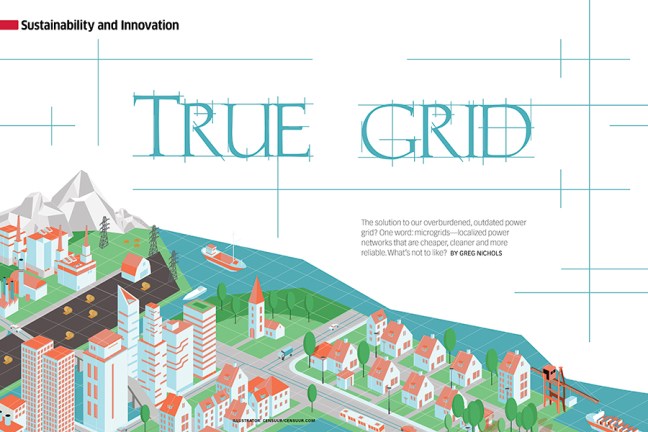
The solution to our overburdened, outdated power grid? One word: microgrids—localized power networks that are cheaper, cleaner and more reliable. What’s not to like?
By Greg Nichols
In late 2000 and early 2001, rolling blackouts swept across California. Demand had exceeded supply. The grid—a byword for any of the vast, interconnected systems of power plants and distribution lines that span every developed nation—was critically overburdened. All at once, frantic residents caught a glimpse of just how tenuous their grip on modernity was.
The blackouts seemed like a fluke, a perfect storm of poor planning, recent deregulation and long-standing unwillingness on the part of the major utility companies to work together. Then they kept happening, and with greater frequency.
Like many essential institutions, the Santa Rita Jail, in Alameda County, California, was spared darkness, thanks to a special allowance. But it was still forced to ration its electricity usage, and with 4,000 inmates, 10,000 fluorescent light fixtures, and 12,000 meals to serve every day, that was a burden. The facility requires 3 megawatts (MW) of constant, reliable electricity to maintain normal operations, enough power to serve the equivalent of 2,700 homes. After cutting its usage by as much as half, the jail limped along at partial capacity. An extended crisis would have impacted basic security, a serious concern at a facility that houses violent offenders.
County administrators took notice, and then they took action. First they approved a plan to install rooftop solar panels. The resulting array would become the largest rooftop solar electric system in the U.S. and the fourth-largest in the world. Able to produce 1.14MW, it covers a full 3 acres (1.2 hectares).
“The decision to expand solar electric generation capacity at the Santa Rita Jail was easy because the economics were so compelling,” says then–Alameda County supervisor Scott Haggerty. The net savings for the county totaled $400,000 (€365,000) in the first year of operation, and the project is expected to save about $15 million (€13.67 million) over its 25-year life. Better still, the solar arrays reduced the facility’s peak summer consumption of electricity delivered over the grid by as much as 25 percent.
But this story is about much more than California. Thrilled with the results and the positive publicity—a rarity for a jail in California—Alameda County began to view Santa Rita as a test bed for its wildest green energy ambitions. “Hopefully we would be a trendsetter for others to follow,” says Haggerty. In 2012, that thinking culminated in one of the largest microgrid projects in the world.
Microgrids are localized power networks that integrate with and augment existing grids. A microgrid system can function independent of the grid, producing power locally using a constellation of renewable energy technologies and distributing power across areas perhaps the size of a neighborhood or a few city blocks. When demand is high, microgrids can draw extra power from the larger grid. When demand is low, microgrids feed power back into the grid, alleviating upstream pressure.
Microgrids are not a specific type of technology. Rather, they are an intelligent strategy that utilizes available renewable energy technologies side by side on a local scale. Because they rely on resources like wind and solar, they don’t pollute like their fossil-fuel-burning big brothers.
By the same token, their operating costs are not tied to fluctuations in global energy markets. By drawing from the grid only when necessary, they extend the capacity of the entire power infrastructure, making it far less prone to failure from overuse.
As it becomes clearer and clearer that no single renewable energy source will be able to replace fossil fuels altogether in the foreseeable future, microgrids offer a compelling and highly intuitive alternative: bundle clean energy solutions and deploy them on a local level.
The grid, the one that likely crisscrosses whatever country you’re in right now, is essentially a big machine. The U.S. grid, in fact, is considered the world’s largest machine, and that helps explain why it is no longer sustainable to keep growing and maintaining it in the face of ballooning demand.
A product of the 19th century, the grid relies on high-voltage transmission lines to carry electricity from power plants to substations, where the voltage is reduced and the power is distributed to homes and businesses. The core technology and the concept of stretching long wires to connect users to the point of production have not progressed much in the past hundred years.
What have changed are demographic pressures and the world economy. Demand for electricity in China and Africa is growing, requiring new transmission solutions. A comprehensive grid spread across vast swaths of either area would be prohibitively expensive. A typical overhead single-circuit transmission line costs between $285,000 and $390,000 per mile (€160,000–€220,000 per kilometer), depending on voltage. In places like the U.S., where infrastructure is aging, about 1 percent of transmission lines have to be replaced annually.
There are also grave environmental concerns associated with replicating grids like those found in the U.S. or Western Europe, where power production is centralized in carbon-dioxide-emitting plants that serve vast regions.
“One analogy,” says Matt Renner, executive director of the World Business Academy, a Santa Barbara, California–based think tank and policy organization that advocates for new energy solutions, “is that when the old telephone system required copper wire to make calls, only 25 percent of the population had access to telephones. But when we freed people from the need to use wires, suddenly 90 percent of the population has access.” If you’re looking to electrify the developing world, in other words, it won’t be by building a continental grid across Africa. Another solution is necessary, a new approach.
But demand is growing in the U.S. and Europe, too, and the existing grid can’t keep up. In Europe, residential electricity consumption will climb 16 percent by 2020, taxing systems that are already overburdened. There is a stopgap in place, but it’s both limited and archaic. At times of high demand, such as warm summer months, nuclear and coal-burning power plants aren’t sufficient. That’s when peaker plants, powered by natural gas, kick into action. The plants are expensive to run and maintain, and that cost accounts for “peak hour” charges on utility bills all around the world.
Meanwhile, demand on the grid is growing much faster than the underlying infrastructure, which requires a fortune just to keep operational, and when peak demand gets too high, which can happen on especially hot days, rolling blackouts occur. When loads are low, on the other hand, the grid produces too much capacity, resulting in waste and unnecessary pollution.
In addition to the Santa Rita project and a handful of others distributed around North America, microgrids have been tested in Canada, Great Britain, Germany, Spain, Japan, China and South Korea, to name a few of the countries taking the lead on research. Asian microgrids have predominantly focused on remote regions where infrastructure is scarce, a pressing need in many places across the continent.
In countries like Germany, on the other hand, which has pledged that 80 percent of its power will come from renewable sources by 2050, the research has focused on average towns and hamlets. The results have been encouraging—a 2013 grid project in Wildpoldsried, a small town of 2,500, resulted in five times more energy produced than residents use, on average—but as with implementation of any new renewable energy concept, the exact path still isn’t clear.
“We need the will to do it,” says Renner. “We need to harness market forces to incentivize the transition. The technology behind the concept is already here.”
Fortunately, the political will is starting to arrive also.
Germans love solar power. The country’s solar capacity is large enough to meet half of its midday energy needs, and about 80 percent of its panels are located on community rooftops. That’s made it a model for an international community scrambling to shore up its energy infrastructure while curbing CO2 emissions.
In the short term, as Germany and far more isolated projects like the one at the Santa Rita Jail have demonstrated, solar is the most viable way to generate a substantial portion of community electricity in much of the world. But experts caution that focusing on a single renewable technology, like solar, comes at the expense of a longer-term renewable energy solution that leverages the strengths of all available technologies. In other words, the best outcome will probably not be a choice between Denmark’s windmills and Germany’s solar panels, but a melding of the two.
Utility executives and policymakers need to see substantive proof that a concept like that is viable, and it needs to hit close to home. As it stands, penetration of renewables in the U.S. energy sector is limited to about 15 percent of total energy production, and despite Germany’s success, using local renewable energy to power U.S. communities is a fairly new concept. In the European Union, the picture is somewhat better, but renewable sources still account for just 24 percent of overall energy production, meaning there’s a big gulf to bridge.
Because the existing transmission-and-distribution system is so complex, the only way to prove the viability of a community-wide microgrid that can plug into existing grids is with robust modeling. It’s not a sexy topic, but it’s where the Clean Coalition, a nonprofit advocating for a reduction in large fossil-fueled power plants, has chosen to puts its efforts. Clean Coalition executive director Craig Lewis believes that developing microgrid technology will entail a thorough examination of the distribution grid infrastructure. That means investigating how all the wires operate at a local level, looking at all the load profiles for buildings, and finding the best places to put solar on rooftops.
In 2013, Lewis convinced power supplier Pacific Gas & Electric (PG&E) to collaborate on a groundbreaking project in the Bayview and Hunters Point neighborhoods of San Francisco. The Hunters Point Project was designed to prove the technical and economic feasibility of utilizing high penetrations of local renewables, primarily solar, to power a system that wasn’t fully grid-reliant. The idea was to create a model that would be easy to replicate in other areas of the grid. If successful, any community could conceivably use the Clean Coalition’s approach to evaluate microgrid opportunities and begin implementing their own system.
Collaboration from the local power utility was crucial, and in some ways unexpected. “Certain utilities and key people in those utilities recognize this is a future they can’t ignore,” says Greg Thomson, programs director of the Clean Coalition, “and others are slower to come around.”
On the surface, utilities stand to lose if microgrids gain ground, because the cheap renewable power generated will reduce demand for utility-generated power. But peak transmission infrastructure is expensive to maintain, and smart utilities also see a business opportunity from microgrids. One clear opportunity is to invest in resources like community batteries or fuel cells, which might be leased for profit.
“We did our advanced power-flow modeling using data that PG&E gave us,” says Thomson. “We went through it with their key staff to validate accuracy. They really saw this as a win-win, and we wouldn’t have arrived at that point if it hadn’t been for their cooperation.”
The coalition’s modeling effort became the basis for methodology that was incorporated into a landmark California Public Utilities Commission ruling to set standards for penetration of renewables into California’s grid architecture. The ruling prompted the major electrical corporations to file new resource-distribution plan proposals in July of this year, and microgrids have been factored into most of those plans.
The Hunters Point Project has also become the headline effort in the Clean Coalition’s Community Microgrid Initiative. The first phase of the project effectively demonstrated that local renewables, rooftop solar in particular, can fulfill at least 25 percent of total electric energy consumption while maintaining or improving power quality, reliability and resilience overall. The team also discovered that the current approach to solar implementation, which is to convert one residential rooftop at a time, is ineffective and ultimately too slow to make much of an impact.
As it stands, solar accounts for less than 2 percent of the energy Americans consume nationwide. China is the fastest-growing market for solar energy and has a supply of up to 23 gigawatts, but that still trails the 36GW supply of Germany, a country with a population about 6 percent of China’s. The world potential for rapid growth, in other words, is substantial.
One of the biggest opportunities the coalition found was the true promise for solar arrays on industrial rooftops. There is symmetry and elegance to this approach. Industrial users are the largest consumers of electricity in developed countries, and industrial buildings have a lot of roof space, which can be utilized for solar arrays.
Peak hours for industrial energy use are typically midday, when the sun is at its highest, and demand drops off dramatically at night. Industrially zoned areas also have robust transmission infrastructure to handle heavy loads, meaning a solar array could plug in with minimal retrofitting. Finally, savvy business owners are generally quicker than homeowners to recognize cost savings and invest in infrastructure improvements to achieve them.
“We look at the whole picture and do a full benefits analysis of local energy versus centralized carbon-based fuels,” says Thomson. “At Hunters Point, we figured out we could get 50MW from solar, and you achieve cost parity to natural gas in just two years with $200 million in economic impact locally and $100 million in added local wages.”
The Hunters Point Project proved what anyone paying attention to renewable energy would already know: an integrated micro-grid system based around the most viable green energy solutions is more reliable and efficient and ultimately cheaper than a centralized production approach.
Because you’re building an electrical system based on predictable long-term energy prices, paying for hardware up front and amortizing the cost over 20 years, it’s also very predictable. After all, the sun keeps shining and the wind keeps blowing, whereas oil and gas have to be discovered and extracted over and over, at great cost.
“The alternative is to pay for energy where the cost is variable and subject to world economic impacts and geopolitical forces,” says Thomson. “If you look at estimates for natural gas, it’s going up, no question.”
This April, Elon Musk, who not only heads Tesla Motors and SpaceX but also SolarCity, an installer of home solar panels, announced the release of a new Tesla product, a large-capacity battery called the Powerwall that can be used in homes and small businesses. The press proclaimed the beginning of the end for fossil fuels. The new battery would put consumers in control of energy consumption.
Tesla reveled in the publicity, making bold proclamations that the device would lower utility costs for millions of consumers by allowing them to go off the grid and run on stored power during peak hours, when energy rates are highest. The battery could also enable customers to go off the grid altogether by allowing them to generate electricity at home from rooftop solar panels and store it for use at night. Centralized coal- and nuclear-powered generators would soon be a thing of the past.
Like any good salesperson, Musk is really selling freedom and peace of mind.
But not everyone is buying it. Batteries have long been the most popular commercial approach to storing energy, but there is growing interest in the viability of fuel cell technology as an alternative. Fuel cells use the chemical energy of hydrogen to cleanly and efficiently produce electricity. If hydrogen is the fuel, electricity, water and heat are the only products, which means working fuel cells are much greener than chemistry-based batteries. They can provide power for systems as large as a utility power station and as small as a laptop computer, making them more flexible than batteries as well.
Toyota recently announced plans to pursue electric vehicles that run off fuel cells, abandoning a competing battery-based concept, and industry watchers believe the carmaker may give Tesla a run for its money if it can perfect the technology.
The downside is that there isn’t currently a clean, renewable source of hydrogen. The gas is currently used in heavy industrial applications and is being produced from natural gas. Producing hydrogen from water requires the use of an electrolyzer, an electrochemical device that breaks H20 into its component parts, and though the technology has existed since the 18th century, it will take substantive investment to scale hydrogen production to necessary levels.
As with everything else, it all comes back to political and commercial will.
In the long run, Tesla’s “battery in every home” approach amounts to privatizing electricity generation on a house-by-house basis. The powerful desire to solve the climate crisis and a general distaste for utility companies makes the notion seem appealing, but it needs to be examined more closely.
Though ostensibly in line with decentralization efforts like those of the Santa Rita Jail in Alameda County or the test beds in Germany, China and elsewhere, Musk’s vision is distinct from a microgrid-oriented approach, which puts power in the hands of communities.
Rollout of consumer-based power generation from green technologies has been incredibly slow in the U.S., despite demonstrable economic benefits to many customers, which makes the future penetration rate for Musk’s home batteries uncertain. If the batteries are a hit, a deeper problem is looming: the solution will work only for those able to afford a $3,500 (€3,200) battery and the additional setup costs of the solar panels. That could lead to a dangerous divergence between a new class of power haves and have-nots.
For all its problems, the grid is a collective infrastructure, and there is a beneficial and democratizing effect to maintaining a power supply as a shared public apparatus. Households that can’t pay for a power-generation-and-battery setup like the one Tesla envisions would be stuck buying energy from an outmoded grid, one that will become increasingly expensive to maintain as more and more consumers pull out.
It’s a bit like the scenario in which rich parents put their kids in private school and then get tax exemptions that don’t require them to help fund the public school system. “If you have a battery and solar panels,” says Matt Renner, “you have your own home microgrid, but one that cuts you off. It’s not scalable.”
The attractiveness of Tesla’s Powerwall in the U.S. demonstrates the widespread belief that freedom equates to privatization and that environmental problems can be solved with consumer empowerment. But micro-grid solutions provide a tremendous opportunity to shore up local communities while providing all the benefit of a power distribution infrastructure built around sustainable resources.
In fact, the microgrid approach is as much a tool for social and economic justice as a play for sustainability.
Fortunately, at least for now, politicians seem to be rallying in support of microgrid efforts. “Microgrid has real wind for everyone across the spectrum,” says Renner. “The right loves independence, self-reliance and hates monopolies. The left loves the green energy component, getting away from fossil fuels. It really is a windfall all around.”
A windfall it is, indeed. Two years after Hurricane Sandy hit the Eastern Seaboard of the U.S. in 2012, New York governor Andrew Cuomo announced that he would be allocating $40 million (€36 million) for a competition aimed at creating “indepen-dent, community-based electric distribution centers.”
The competition is part of a larger $17 billion (€15.5 billion) plan in New York to shore up the grid against clear vulnerabilities and future outages related to inclement weather and overcapacity.
Meanwhile in California, Governor Jerry Brown signed a bill reauthorizing the Self-Generation Incentive Program in June 2014. Over the next five years, the bill will provide $415 million (€378 million) in incentives to develop renewable energy sources at the community level, including solar, wind turbines and waste heat. It will also help California reach its 2020 goal of adding 1.3GW of storage to its grids.
And last year, Japan allocated $21 million (€19 million) over three years for investment in smart-grid development, spurring a flurry of new projects. Worldwide, microgrid proj-ects account for about 12,000MW of capacity, nearly triple the figure from last year. The bulk of that supply comes from projects in North America and Asia-Pacific.
For the time being, microgrids account for a small fraction of global capacity. But existing projects are proving the viability of the concept and helping acquaint people with a future that isn’t reliant on an inherently fragile system.
“If you look at the opportunities,” says Thomson, “you can get quite a bit of local renewable generation and optimize it. That’s the future.”
DC: Becoming current again
By Cintia Taylor
More than a century after Thomas Edison lost his battle, the debate about AC/DC (no, not the band) is back on the table. If he wins this time, the world wins as well.
Thomas Edison may be laughing out loud from his grave. More than a century after losing the battle to alternating current (AC), Edison’s direct current (DC) is now making a comeback. It’s enough to make us smile, too. Electronics all run on DC power. Adopting Edison’s system would spell the end for the large losses incurred when this energy is converted, and that would mean lower CO2 emissions.
AC and DC are two competing systems for distributing energy. DC flows energy in one direction: from a battery or power station to an appliance and then back to the origin. The stream of electricity is constant and can be easily controlled in terms of quantity, that is, a DC grid can provide the exact amount of electricity needed to operate an appliance or run a building. In AC, however, electrons flow back and forth between origin and destination. The transmission is not constant, and the system struggles to match the amount of energy produced with what is consumed.
Back in the late 19th century, Edison’s company, General Electric, was the leader in supplying electricity, using a DC grid. But there was a problem: the current lost its power after a mile of distribution. The network therefore required several power stations in order to work effectively. Then, Edison’s former employee Nikola Tesla was hired by rival company Westinghouse Electric to improve the competing system. The invention of the transformer aided Tesla in tweaking AC to transmit high voltages of electricity at long distances. The voltage could easily be reduced later to supply consumers.
For about a decade, Edison and Tesla led incessant campaigns, involving both American and European companies, to prove their system was the best. In the end, AC won the so-called War of the Currents. Its ability to transmit at long distance required fewer (albeit bigger) power generation stations than DC. It thus made for a cheaper and more manageable system. And that is how, by the end of the 19th century, AC became the dominant system all around the world.
It was a very different era, in which electricity was used mainly to power lightbulbs and motors, mostly in an industrial context. But just have a look around your desk, living room or kitchen and you realize how dependent we’ve become on electricity for all our appliances and gadgets.
While power plants and electric grids produce AC, most electronics run on DC. That’s because batteries (which are the heart of electronics) produce DC energy. So every time we plug in our laptop or charge our mobile phone, a transition process from AC to DC takes place in the charger. The same goes for electric cars, solar panels, and anything that is operated on batteries. The transformation not only causes loss of electricity, but also forces the use of extra energy for fans to cool down the heat released in the process. It is not for nothing that top tech companies are switching to DC to power their data centers: the energy bill tells the story.
Having to convert AC to DC also means electronics chargers have to allocate space in their systems for the transformer and use more materials. In a world that is increasingly dependent on DC-run electronics and obsessed with smaller and lighter gadgets, it is only logical that the AC/DC discussion should be back on the table. Having a DC grid instead of an AC system would mean no more unnecessary conversions, and thus savings on materials and protection of the environment.
“The War of the Currents never stopped. We’re now ending it once and for all,” jokes Dutch entrepreneur Harry Stokman, whose company, aptly named Direct Current Ltd., is leading the world in large-scale projects making use of DC grids. His business model is to raise as much awareness as possible about the benefits of changing to a DC grid. He does so in cooperation with grid operators and universities, and with the support of the Dutch government, which turns a blind eye to legislation to allow experiments such as the one Stokman’s company is leading in a greenhouse in the municipality of Haarlemmermeer, southwest of Amsterdam.
Energy conditions in greenhouses are very controlled and highly efficient. But by powering the 2.4-acre (1-hectare) area with a DC grid, Stokman has seen savings of up to 5 percent in conversion and up to 30 percent in gas usage. Plus, the DC system requires only half of the 22,000 pounds (10,000 kilograms) of copper used by the AC grid. The results make a compelling case for the switch to DC.
Northern European governments have been supporting several initiatives to encourage citizens to use more clean energy. Yet, while consumers think they are going greener, the truth of the matter is that they are not carbon neutral. Solar panels work on DC. All the energy they produce is converted to the AC grid—and then back to DC when the homeowner makes use of electricity. As Stokman puts it, cynically: “You can plant tomatoes, and when they’re ripe you have two choices: you either eat them directly, or you sell them to a shop, only to buy them later and eat them.”
An additional advantage of DC is that, unlike AC, it can produce the exact amount of energy the consumer needs. Instead of having supergrids, society could be powered by several smaller, self-sufficient grids run on DC. Think of common local energy companies co-owned by the energy operators and a group of people such as the owners of flats in a building or the residents of a neighborhood. Within the system there would be no waste of energy, and voilà: carbon-neutral living.
Economist and entrepreneur Gunter Pauli says the micro-management provided by a DC network is its greatest power because it allows to regulate and implement at a local level. “Instead of having a vein and an artery, which would be the AC network, we’re going to work with the nerve system,” Pauli says. “It means we have much finer tune, much more local connection, and self-control.”
The control over electricity use is a crucial point that Pauli makes. Indeed, with DC, consumers could also opt for energy packages just like those provided by Internet operators. Today we pay for energy by the kilowatt-hour; it’s just like how we paid for Internet service in the early days, by minutes used. With DC grids, consumers could request a specific amount of energy to be delivered to their home per designated period of time—just like they choose a specific amount of data per second from their Internet provider. The difference in people’s pockets would be more visible: you would be able to consume only what you have. If consumers wanted more, they would have to upgrade to a more expensive package—and that would make families think twice before they wasted energy.
Supporters of DC agree that it has less impact on health as well. The tall transmission towers with their mazes of electrical cables blotting the landscape are necessary for the distribution of AC, but entirely dispensable in a DC grid system, where cables can go underground and underwater, where they are also less prone to accidents.
And if all these arguments weren’t satisfying enough, there is the issue of the saturation of the AC grid. In the Netherlands alone, the cost to renew and upgrade the AC infrastructure to meet the needs of the future is estimated to cost some $67 billion (€60 billion). Stokman says it would take less than half to convert the country to a DC infrastructure. He adds that there is no need for massive works. The AC cables can be reused for DC. According to him, it would only mean having to break down a few transformer stations and make minor adjustments at people’s homes.
The new emerging economies in Africa and Asia will also play a role in dictating what the electric world will look like in the future. Unlike in European and U.S. societies, electric grids have to be built from scratch there, and taking into account what experts know today, the logical solution will be DC. Stokman’s company is involved in projects in India and South Africa, where there are plans to wire up a whole township with a DC grid.
So did we choose the wrong system back in the 1880s? “If it weren’t for Tesla, we’d be primitive in terms of energy,” says Stokman. But new technology has allowed for a return to Edison’s idea. And now, it seems to make sense to wire the world in a different current.
















 Diane Hoover



 sustainableroguevalley.org